
FUE vs FUT Hair Transplant: What Is the Difference?
By Dr. Sushrut Tated, plastic surgeon
FUE vs FUT hair transplant differs only in how grafts are taken from the back of the scalp. FUT removes a thin strip and leaves one fine linear scar, often giving more grafts per session. FUE takes follicles one by one and leaves tiny dot scars, suiting short hairstyles. Growth results are similar when done well. See hair transplant.

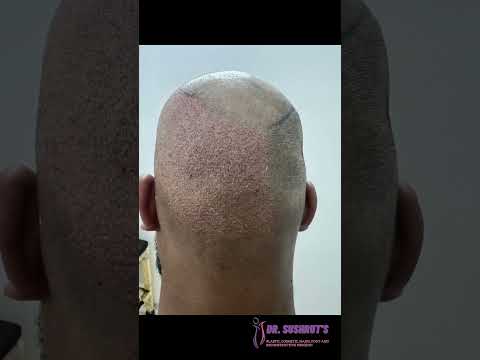
Dr. Sushrut explains hair transplant



What do FUE and FUT have in common?
Both are follicular unit hair transplants. Hair from the back and sides of the scalp, which is resistant to pattern baldness, is moved to thinning or bald areas. In both methods the hair is taken as natural groups of one to four hairs called follicular units, and placed into tiny slits in the recipient area at the angle and direction of natural hair. The difference is only in how the donor hair is harvested.
How does FUT work?
In follicular unit transplantation (FUT), also called strip surgery, the surgeon removes a thin strip of scalp from the back of the head under local anaesthesia. The edges are stitched together, leaving a fine line hidden by the hair above it. The strip is divided under magnification into individual follicular units, which are then implanted.
How does FUE work?
In follicular unit excision (FUE), each follicular unit is removed directly from the scalp with a tiny circular punch, usually under 1 mm wide. There is no strip and no stitches. Each extraction leaves a small round mark that heals as a pale dot. The donor area is usually trimmed short for the procedure.
FUE vs FUT at a glance
| FUT (strip) | FUE | |
|---|---|---|
| How grafts are taken | Strip removed, divided under magnification | Units punched out one by one |
| Donor scar | One fine linear scar | Many small dot scars |
| Grafts per session | Often more | Usually fewer, can be split over days |
| Stitches | Yes, removed in about 10 to 14 days | No |
| Donor area shaving | Only the strip area | Usually trimmed short |
| Short hairstyles later | Line may show with very short cuts | Better suited |
| Donor discomfort | Tightness for a few weeks | Mild, settles in days |
| Time in procedure | Shorter for the same number of grafts | Longer |
Which method suits whom?
FUE may suit you if:
- you like to keep your hair very short;
- you need a moderate number of grafts;
- you have a tight scalp or a previous strip scar;
- you want body or beard hair used as an extra donor source.
FUT may suit you if:
- you need a large number of grafts in one session;
- you keep your hair long enough to cover a fine line;
- you want to preserve donor density for a possible later session.
Many surgeons offer both and some combine them. Dr. Sushrut performs both FUE and FUT and recommends one after examining your donor area, the pattern of loss and your hairstyle.
What happens on the day?
- Planning: the hairline and areas to be treated are marked and agreed with you.
- Anaesthesia: the scalp is numbed with local anaesthetic; you stay awake.
- Harvesting: by strip (FUT) or punch (FUE).
- Implantation: grafts are placed in the recipient area. A session can take several hours.
- Going home: usually the same day, with instructions for washing and sleeping.
Recovery and growth timeline
| Time | What to expect |
|---|---|
| First week | Small crusts on the grafts; mild swelling of the forehead is common |
| 10 to 14 days | Crusts gone; FUT stitches removed |
| 2 to 8 weeks | Most transplanted hairs shed; this is normal |
| 3 to 4 months | New hair starts to grow |
| 6 months | Visible improvement in density |
| 12 to 18 months | Final result assessed |
Risks to discuss with your surgeon
Bleeding, infection, swelling, numbness of the donor or recipient area, visible scarring, temporary shedding of nearby native hair, an unnatural hairline if poorly designed, and over-harvesting of the donor area, especially with FUE done too densely. Results depend on donor supply; no technique creates new hair.
Myths about FUE and FUT
- “FUE is scar-free.” It leaves many small dot scars.
- “Transplanted hair falls out, so it failed.” Shedding in the first weeks is expected; regrowth follows.
- “One transplant stops all hair loss.” Existing hair may continue to thin and may need treatment.
- “Anyone with hair loss can have a transplant.” You need a stable pattern and enough donor hair.
What affects the cost?
The number of grafts, the technique, the time in theatre and follow-up care are the main factors. A quote per graft means little without knowing how many grafts you need and how the donor area will be protected.
What to ask before choosing
- Is my hair loss stable enough for a transplant now?
- How many grafts will I need, and how much donor hair do I have?
- Would FUE, FUT or both suit me, and why?
- Will I need medicines or PRP alongside?
For assessment, suitability and the procedure itself, see hair transplant. For non-surgical options, read GFC vs PRP for hair loss or see platelet rich plasma therapy.
Frequently asked questions
Is FUE better than FUT?
Neither is better for everyone. Studies comparing the two find both produce good-quality grafts. FUE avoids a linear scar; FUT can move more grafts in one sitting and spares the donor area for later sessions. The right choice depends on your hair loss, donor area and hairstyle.
Which leaves less scarring, FUE or FUT?
Both leave scars. FUT leaves one fine line hidden by hair above it. FUE leaves many tiny round dots spread across the donor area, which are less noticeable with very short hair.
How long does it take to see results?
Transplanted hairs usually shed in the first few weeks, new growth starts at about three to four months, and the final result is judged at around 12 to 18 months.
Can FUE and FUT be combined?
Yes. Some patients have FUT and FUE in the same or later sessions to increase the total number of grafts while protecting the donor area.
Will I still need medicines after a hair transplant?
Often, yes. A transplant moves hair but does not stop ongoing loss of the existing hair, so medicines or treatments such as PRP or GFC may be advised to protect it.
References
- Hair Transplantation (StatPearls). NCBI Bookshelf, StatPearls Publishing.
- Hair transplant practice guidelines. PubMed Central (NIH).
- Follicular unit extraction (FUE) hair transplant: curves ahead. PubMed Central (NIH).
- Old friend or new ally: a comparison of follicular unit transplantation and FUE. PubMed.


