
Hair Transplant in Pune: FUE and FUT Hair Restoration
A hair transplant moves hair follicles from the back and sides of the scalp, where hair resists balding, to thinning or bald areas. Follicles are taken one by one (FUE) or from a thin strip of scalp (FUT). It is done under local anaesthesia; new hair grows after a few months and the full result takes about a year.

Dr. Sushrut explains hair transplant

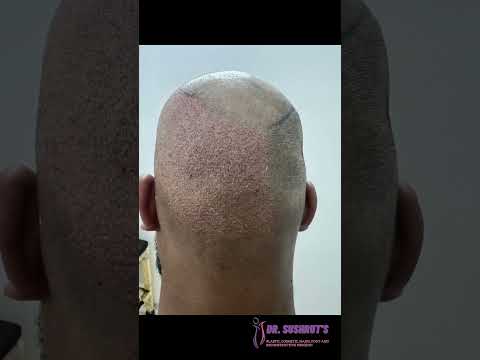


What each video covers
- Hair transplant resultA hair transplant result at the clinic.
- Hair transplant: case updateA short update on a hair transplantation case.
- Do hair-loss products work?Dr. Sushrut discusses whether common hair-loss products work and when to seek medical treatment.
What is a hair transplant?
In male and female pattern hair loss (androgenetic alopecia), follicles on the front and crown of the scalp gradually shrink. Follicles at the back and sides are usually resistant to this process. A hair transplant moves some of these resistant follicles to the thinning areas, where they keep their resistance and continue to grow.
Hair grows naturally in groups of one to four hairs called follicular units. Modern transplants move these units individually, which gives a natural hairline when they are placed at the right angle and density.
Transplants are also used to restore hair in scars, for example after burns or injuries, and in eyebrows or beards. Scar tissue has a poorer blood supply, so growth can be less predictable.
Who may benefit, and how is suitability assessed?
You may be suitable if you have pattern hair loss that has been assessed, a good donor area, realistic expectations about density, and good general health.
At consultation the doctor will:
- Confirm the cause of hair loss: pattern loss, or another cause such as thyroid disease, iron deficiency, alopecia areata or hair pulling, which need different treatment.
- Map the pattern and stage: hairline, temples, mid-scalp and crown.
- Assess the donor area: density, hair thickness, curl and colour contrast with the skin.
- Think ahead: how your hair loss may progress, so that the hairline still looks natural in 10 to 20 years.
- Discuss medical treatment, such as minoxidil or, for men, finasteride, which help protect the hair you still have.
What are the treatment options?
| Option | What it can do | Limitations |
|---|---|---|
| FUE (follicular unit excision) | Follicles taken one by one; tiny dot scars; suits short hairstyles | Donor area shaved; slower for very large sessions |
| FUT (strip method) | Many grafts from a thin strip; donor hair often not shaved | Linear scar at the back of the head |
| Medical treatment (minoxidil, finasteride) | Slows loss and may thicken existing hair | Ongoing use; possible side effects; prescription needed for finasteride |
| PRP therapy or GFC treatment | May improve thickness of existing thinning hair | Evidence still limited; repeat sessions; no new follicles |
| Hair systems or camouflage | Immediate look of density | Maintenance; not your own growing hair |
Many people combine a transplant with medical treatment to protect the hair that is not transplanted.
How is a hair transplant performed?
- Planning: the hairline and areas to be treated are drawn and agreed with you.
- Anaesthesia: local anaesthetic is injected into the donor and recipient areas.
- Harvest: follicles are removed one by one with a small punch (FUE), or a thin strip is removed and the wound closed (FUT).
- Preparation: grafts are kept cool and moist, and sorted by the number of hairs.
- Recipient sites: tiny slits are made in the thinning area at the angle and direction of natural hair.
- Placement: grafts are placed into the slits, single-hair grafts at the hairline and larger units behind.
You go home the same day with instructions on washing and sleeping.
How should you prepare, and what should you ask?
- Stop smoking, and avoid alcohol for a few days before.
- Tell the doctor about all medicines, including blood thinners and supplements.
- Follow any advice about haircuts or shaving before the procedure.
- Arrange a few days off if you would rather not be seen with scabs.
Questions to ask:
- How many grafts do I need, and how many can my donor area safely provide?
- Who will perform each step of the procedure?
- How will you design a hairline that still suits me as I age?
- What medical treatment should I continue?
What is recovery like?
| Time | What to expect for most patients |
|---|---|
| Days 1-3 | Mild soreness; sleep with the head raised; swelling of the forehead is common |
| Days 7-10 | Scabs fall off with gentle washing; FUT stitches removed if used |
| Weeks 2-8 | Most transplanted hairs shed (expected) |
| Months 3-4 | New hairs start to grow, thin at first |
| Months 6-9 | Clear improvement in density |
| Around 12 months | Full result, sometimes later at the crown |
What are the risks of a hair transplant?
- Swelling, bleeding and numbness of the scalp, usually temporary.
- Infection and folliculitis (inflamed hair follicles), usually minor.
- Shock loss: temporary shedding of existing hair near the treated area.
- Poor growth of some grafts.
- Unnatural appearance if the hairline is too low or the angle is wrong.
- Donor-area scarring: dot scars with FUE, a linear scar with FUT, and visible thinning of the donor area if too many grafts are taken.
Contact the clinic if you have spreading redness, pus, fever or severe pain.
What results can you expect?
Transplanted hair usually keeps growing long term. Density is lower than a full natural head of hair, because donor supply is limited. Results depend on your donor hair, hair thickness and how your non-transplanted hair changes over time.
What affects the cost of a hair transplant in Pune?
- Number of grafts and the size of the area treated.
- Technique: FUE or FUT.
- Number of sessions planned.
- Medicines and follow-up visits.
Hair transplants are usually not covered by insurance unless the hair loss follows a burn or injury and your policy covers reconstruction. Be cautious about very low per-graft prices: experience, safety and the time spent on each graft matter more.
Questions about hair transplant
Which hair transplant is permanent?
Both FUE and FUT move follicles from the donor area, which is resistant to pattern balding, so transplanted hair usually keeps growing long term. What is not protected is your own non-transplanted hair, which may keep thinning; that is why medical treatment is often continued.
Can a hair transplant be done twice?
Yes, if enough donor hair remains. A second session is sometimes planned to add density or to treat areas that thin later. Donor hair is limited, so the plan should consider future hair loss.
FUE or FUT: which is better for me?
FUE leaves tiny dot scars and suits people who like short hair. FUT leaves a fine linear scar at the back of the head that is hidden by longer hair, and can yield many grafts in one session. The choice depends on your donor area, hairstyle and how many grafts you need.
Is a hair transplant painful?
The scalp is numbed with local anaesthetic injections, which sting briefly. After that most people feel pressure rather than pain. Soreness and tightness for a few days afterwards are usually managed with simple painkillers.
Can women have a hair transplant?
Some women can, for example those with a stable, localised area of thinning or a high hairline, and enough donor hair. Many women have diffuse thinning that also affects the donor area, and medical treatment is usually tried first.
Why does transplanted hair fall out after a few weeks?
Most transplanted hairs shed in the first few weeks. This is expected: the follicle stays in the skin and starts growing a new hair after about three to four months.
Hair transplant vs PRP: which do I need?
PRP does not create new follicles; it may help existing thinning hair. A transplant moves follicles to areas that are bald or very thin. Some people use both. See PRP therapy.
At what age can I have a hair transplant?
There is no fixed age, but surgeons are cautious in young men in their early twenties, because the final pattern of hair loss is not yet clear and further loss can leave transplanted hair isolated.
Consultation for hair transplant
Consultations are in person at Dr Sushrut’s Plastic and Cosmetic Surgery Clinic, Sayar Clinic, Ayodhya Complex, in front of Canara Bank, Bibwewadi, Pune 411037. Hours: Monday to Saturday, 5-9 pm.
Appointments are booked by phone call or WhatsApp on +91 98904 34447 (WhatsApp). Bring any previous reports, prescriptions and a list of your current medicines.
References
- Hair Transplantation (StatPearls). NCBI Bookshelf, StatPearls Publishing.
- Hair loss. NHS.
- Systematic Review of Platelet-Rich Plasma Use in Androgenetic Alopecia Compared with Minoxidil, Finasteride, and Adult Stem Cell-Based Therapy. Gentile P, Garcovich S, International Journal of Molecular Sciences, 2020.
- Cosmetic surgery. NHS.


