
Scar Revision Surgery in Pune: Improving Old and New Scars
Scar revision surgery improves the look or function of a scar by cutting it out and closing the skin more neatly, changing its direction, or releasing a tight scar. It is often combined with non-surgical treatments such as steroid injections, silicone or laser. No method erases a scar, but many scars can be made flatter, narrower and less noticeable.

Dr. Sushrut explains scar revision surgery


What each video covers
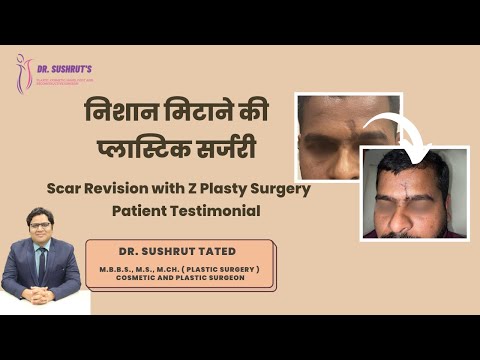
- Scar revision with Z-plastyHow Z-plasty is used to revise a scar so it sits better and is less noticeable.
- Forehead scar revisionA forehead scar revised using an advancement Z-plasty.
- Fractional CO2 laser for scarsDr. Sushrut explains how fractional CO2 laser is used to improve the texture of scars.
- Treating self-harm scarsHow cut-mark scars can be treated with dermabrasion and skin grafting.
- Old scars (Marathi)Whether a long-standing scar can still be improved.
Very minimal cut or small incision, closed with double-layered cosmetic sutures. A very thin, minimal scar is expected after surgery.
What is scar revision?
A scar is the body’s way of repairing skin after an injury, surgery, burn or acne. Most scars become flatter and paler over a year or more, but some stay wide, raised, sunken, dark or tight. Scar revision is any treatment that improves how a scar looks or works. Surgery is one part of it; non-surgical treatments are another, and the two are often combined.
Common reasons people seek revision:
- Wide or stretched scars, often after wounds that healed under tension.
- Raised (hypertrophic) scars that stay within the original wound. Keloids, which spread beyond it, are treated differently; see keloid treatment.
- Depressed or tethered scars, such as acne scars or scars stuck to deeper tissue.
- Scars across natural skin lines, which catch light and shadow.
- Contractures: tight scars that limit movement, often after burns. See burn scar treatment.
- Scars that remind someone of a traumatic event or affect confidence.
Who may benefit, and how is suitability assessed?
At consultation the surgeon examines the scar’s width, height, colour, firmness, direction and position, and checks whether it restricts movement. They ask how and when it happened, how it has changed, whether you form thick scars easily, and about smoking, diabetes and medicines. Photographs are taken to plan and track treatment.
Most scars are revised after they have matured, usually 12 to 18 months after the injury. Earlier treatment may be advised when a scar limits function or is thickening.
What are the treatment options?
| Option | Suits | Limitations |
|---|---|---|
| Silicone gel or sheets, pressure | Raised or new scars | Daily use for months |
| Steroid injection | Raised, itchy hypertrophic scars and keloids | Can thin the skin or lighten its colour |
| Laser (for example fractional CO2) | Texture, acne scars, some flat or raised scars | Several sessions; temporary redness or darkening |
| Subcision and fat grafting | Depressed or tethered scars | Fat may partly reabsorb; may need repeating |
| Excision and layered closure | Wide or stretched scars | Leaves a new, usually finer, line |
| Z-plasty or W-plasty | Scars in a poor direction, or tight bands | Longer but less noticeable lines |
| Skin graft or flap | Large contractures or scars that cannot be closed directly | Larger operation; donor-site scar |
For depressed scars, fat grafting can add volume beneath the skin. Fresh cuts on the face need careful closure from the start; see facial cosmetic stitches.
How is scar revision surgery performed?
- Planning: the new scar is drawn to lie along natural skin creases where possible.
- Anaesthesia: usually local anaesthesia; general anaesthesia for large areas or children.
- Removal or release: the old scar is cut out, or released and rearranged with small flaps (Z-plasty or W-plasty) to change its direction or lengthen a tight band.
- Layered closure: deeper stitches take the tension, and fine stitches or skin glue close the surface.
- Dressing: a light dressing or tape supports the wound.
Non-surgical treatments are often started a few weeks after surgery as the new scar forms.
How should you prepare, and what should you ask?
- Stop smoking well before and after surgery; it harms wound healing.
- Tell your surgeon about any history of thick scars or keloids.
- Avoid sun exposure on the scar.
- Plan for stitch removal and follow-up visits.
Questions to ask:
- Is my scar mature enough to treat?
- Will surgery, non-surgical treatment or both help most?
- What will the new scar look like, and how long will it be?
- How many sessions should I expect?
What is recovery like?
| Time | What to expect for most patients |
|---|---|
| Week 1 | Mild soreness; keep the wound dry and clean as advised |
| Days 5-14 | Stitches removed, earlier on the face and later on the body |
| Weeks 2-6 | Scar is pink and firm; start silicone gel and massage when advised |
| Months 3-6 | Redness fades; laser or injections may be added |
| 12-18 months | The scar reaches its final appearance |
Protect the new scar from the sun with clothing or sunscreen for at least a year.
What are the risks of scar revision?
- A scar that is still noticeable, or wider than hoped, especially in areas that stretch.
- Hypertrophic scarring or keloid return, particularly in people prone to them.
- Infection or wound opening, uncommon.
- Colour change, darker or lighter skin, more common in darker skin types.
- Need for more than one treatment.
Contact your surgeon if the wound becomes red, hot, swollen or discharges, if it opens, or if a scar starts thickening quickly.
What results can you expect?
Revision usually makes a scar less noticeable rather than invisible. Results depend on the scar’s cause, position, your skin type and how carefully the scar is looked after while it matures. Combining surgery with non-surgical treatment often gives the most improvement.
What affects the cost of scar revision in Pune?
- Size, number and position of scars, and whether flaps or grafts are needed.
- Technique mix: surgery alone or with laser sessions, injections or fat grafting.
- Anaesthesia and facility.
- Number of sessions and follow-up visits.
Questions about scar revision surgery
Can a scar be removed completely?
No. Any cut through the full thickness of the skin heals with a scar. Revision replaces a poor scar with a better one, usually thinner, flatter and better placed, so it is less noticeable.
How long should I wait before scar revision?
Scars keep changing for 12 to 18 months, often becoming flatter and paler on their own. Revision is usually planned after this. Earlier treatment may be advised for scars that limit movement, pull on the eyelid or lip, or are thickening.
Is scar revision surgery worth it?
It is most worthwhile for scars that are wide, stretched, depressed, raised, in a poor direction, or tight across a joint. Small, flat, pale scars may gain little from surgery and are often better treated without it.
Scar revision surgery or laser: which is better?
Laser smooths texture and redness and suits acne scars and some flat or slightly raised scars. Surgery changes the width, shape or direction of a scar. Many scars benefit from both, with laser after surgery.
Can keloids be treated with scar revision?
Keloids often come back if they are only cut out, so they need a combined plan, such as steroid injections after removal, pressure or other treatment. See keloid treatment.
Will the revised scar be visible?
Yes, but the aim is a scar that is less noticeable. It will look red and slightly raised for a few months before it fades. Sun protection and silicone gel help it settle.
Does insurance cover scar revision?
Revision for a scar that limits movement or function, for example after a burn, may be covered by some policies. Cosmetic revision usually is not. Check with your insurer.
Consultation for scar revision surgery
Consultations are in person at Dr Sushrut’s Plastic and Cosmetic Surgery Clinic, Sayar Clinic, Ayodhya Complex, in front of Canara Bank, Bibwewadi, Pune 411037. Hours: Monday to Saturday, 5-9 pm.
Appointments are booked by phone call or WhatsApp on +91 98904 34447 (WhatsApp). Bring any previous reports, prescriptions and a list of your current medicines.
References
- Surgical Scar Revision: An Overview. Garg S, Dahiya N, Gupta S, Journal of Cutaneous and Aesthetic Surgery, 2014.
- Scar Revision (StatPearls). NCBI Bookshelf, StatPearls Publishing.
- Laser Revision of Scars (StatPearls). NCBI Bookshelf, StatPearls Publishing.
- Scars: treatment. NHS.
- Scar revision. MedlinePlus, U.S. National Library of Medicine.


