
Tendon Repair Surgery in Pune: Repairing Cut Hand Tendons
Tendon repair surgery stitches together a cut or torn tendon so the finger, thumb or wrist can move again. Flexor tendons bend the fingers and extensor tendons straighten them. A cut tendon does not heal by itself, so repair is ideally done within days of injury, followed by weeks of protected movement in a splint guided by a hand therapist.

Dr. Sushrut explains tendon repair surgery


What each video covers
- About tendon repairThings you should know about tendon repair surgery.
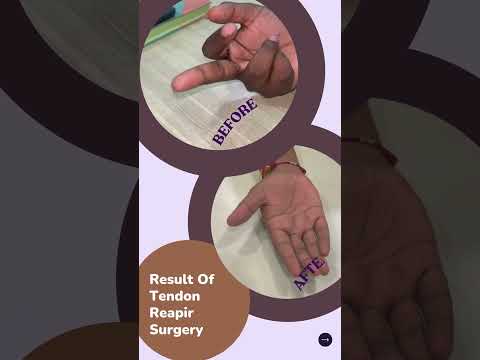
- Hand injury: tendon repairA hand injury treated with tendon repair, with the patient’s testimonial.
- Hand injury: surgery to recoveryA hand injury from surgery through recovery.
Very minimal cut or small incision, closed with double-layered cosmetic sutures. A very thin, minimal scar is expected after surgery.
What is a tendon injury?
Tendons are strong cords that connect muscles in the forearm to the bones of the fingers, thumb and wrist. In the hand they lie just under the skin, so a cut from glass, a knife, a tin lid or machinery can easily divide them.
- Flexor tendons run on the palm side and bend the fingers and thumb.
- Extensor tendons run on the back of the hand and straighten them.
Signs of a cut tendon include being unable to bend or straighten a finger joint, a finger that rests in an unusual position compared with the others, and weakness or pain on gripping. A nerve or artery is often cut at the same time, causing numbness or a pale fingertip.
Why does early repair matter?
The cut ends of a tendon pull apart as the muscle contracts. Within a few weeks they shorten and soften, and the tunnel they glide through starts to scar, making direct repair harder or impossible. Any cut on the hand with loss of movement or numbness should be assessed by a hand surgeon promptly.
Who may benefit, and how is the injury assessed?
The surgeon tests each finger joint, checks sensation and circulation, and examines the wound. An X-ray is taken if a fracture or a piece of glass is suspected. The level of the cut, described in zones, guides how the repair is done and how the hand is rehabilitated.
What are the treatment options?
| Option | Suits | Points to consider |
|---|---|---|
| Primary repair | Clean cuts seen early | The standard treatment |
| Splint only | Some partial cuts and closed extensor injuries such as mallet finger | Strict splint wear for weeks |
| Tendon graft | Delayed injuries where ends cannot be joined | Tendon taken from the forearm or leg |
| Two-stage reconstruction | Scarred tunnels after late presentation | Rod placed first, graft months later |
| Tendon transfer | Tendons that cannot be repaired | A working tendon is rerouted |
Nerve and vessel injuries found at the same time are repaired in the same operation; see nerve repair surgery and vessel repair surgery.
How is tendon repair performed?
- Anaesthesia: a regional block or general anaesthesia; wide-awake local anaesthesia allows the surgeon to watch active movement during surgery.
- Exploration: the wound is extended to find the retracted tendon ends.
- Repair: the ends are joined with strong core stitches and a fine running stitch around the outside to help gliding.
- Associated repairs: nerves and arteries are repaired under magnification if needed.
- Splint: a protective splint holds the wrist and fingers in a safe position.
How should you prepare, and what should you ask?
- Keep the hand raised and the wound covered after injury.
- Do not try to test the finger by forcing it.
- Plan time for regular hand therapy visits over several weeks.
Questions to ask:
- Which tendons and nerves are injured?
- How long must I wear the splint, and what can I do with the hand?
- When can I drive, work and lift?
- What exercises should I do at home?
What is recovery like?
| Time | What to expect for most patients |
|---|---|
| Days 1-5 | Hand raised; splint on; therapy starts with protected movement |
| Weeks 1-6 | Splint worn; exercises several times a day as taught |
| Weeks 6-8 | Splint reduced; light use of the hand |
| About 12 weeks | Gradual return to heavy use and sport |
| Months 3-6 | Movement and strength continue to improve |
What are the risks?
- Adhesions: the tendon sticks to nearby tissue, limiting movement; sometimes a later release (tenolysis) helps.
- Rupture of the repair.
- Stiffness of finger joints.
- Infection of the wound.
- Scar sensitivity and swelling.
- Complex regional pain syndrome, uncommon.
Seek prompt review if you suddenly cannot move the finger after repair, or for fever, increasing pain or wound discharge.
What results can you expect?
With early repair and committed hand therapy, many people regain useful movement and return to work. Results are generally better for extensor than flexor tendons, and better when the injury is clean and treated early.
What happens if a cut tendon is left untreated?
A completely cut flexor tendon does not rejoin on its own. The muscle pulls the upper end back into the palm or forearm, and the finger stays unable to bend at the affected joint, weakening grip. An extensor tendon cut over the last finger joint leaves a drooping fingertip (mallet finger); over the middle joint, the finger can gradually bend into a fixed position (boutonnière deformity). A partly cut tendon may hold for a while but can catch or snap later with use. A splint alone is reasonable for selected partial cuts and closed extensor injuries such as mallet finger. For a complete cut, waiting usually turns a direct stitch into a graft or a two-stage operation.
Common myths about tendon injuries
- “If I can still move the finger a little, the tendon is fine.” Each finger has more than one tendon, so it can still move partly when one tendon is fully cut, and only a careful examination can tell.
- “A small skin cut cannot damage a tendon.” Hand tendons lie just under the skin, so even a short cut from glass or a knife can divide a tendon, nerve or artery.
- “Oil massage and a tight bandage will join the tendon.” Massage and bandaging cannot bring the retracted ends back together.
- “Once the tendon is stitched, the hand can be used normally.” The repair is weak for the first weeks and can snap if the splint is removed early or the hand grips hard.
What affects the cost of tendon repair surgery in Pune?
- Number of tendons and whether nerves or arteries are also injured.
- Timing: early primary repair or delayed reconstruction.
- Anaesthesia and theatre time.
- Splints and hand therapy sessions.
Treatment after an injury is often covered by health or accident insurance, subject to your policy.
Questions about tendon repair surgery
How long does tendon repair take to heal?
Tendons gain strength slowly. The repair is protected in a splint for about four to six weeks, light use follows, and heavy gripping or lifting usually waits until about 12 weeks. Full recovery of movement can take several months.
Can a cut tendon heal without surgery?
A completely cut tendon usually cannot, because the ends pull apart. Some partial cuts and some closed extensor injuries, such as a mallet finger, can be treated in a splint.
Why is hand therapy so important after tendon repair?
Repaired tendons tend to stick to surrounding tissue as they heal. Carefully controlled exercises keep the tendon gliding without overloading the repair. Following the therapy programme has a large effect on the final result.
What happens if tendon repair is delayed?
After a few weeks the tendon ends retract and soften, and the tunnel they glide in scars. Repair becomes harder, and a tendon graft or a two-stage reconstruction may be needed.
Can the repair snap?
Yes, rupture is a known risk, most often from using the hand too forcefully or removing the splint too early. A sudden loss of movement after repair needs prompt review.
Will I get full movement back?
Many people regain good function, but some stiffness or loss of full bending is common, especially after flexor tendon injuries in the finger and with nerve injuries at the same time.
Can I drive with a tendon repair splint?
Usually not while the splint is on, because you cannot grip the wheel safely. Most people wait until the splint is off and their surgeon and hand therapist agree that grip is strong enough.
Consultation for tendon repair surgery
Consultations are in person at Dr Sushrut’s Plastic and Cosmetic Surgery Clinic, Sayar Clinic, Ayodhya Complex, in front of Canara Bank, Bibwewadi, Pune 411037. Hours: Monday to Saturday, 5-9 pm.
Appointments are booked by phone call or WhatsApp on +91 98904 34447 (WhatsApp). Bring any previous reports, prescriptions and a list of your current medicines.
References
- Flexor Tendon Lacerations (StatPearls). NCBI Bookshelf, StatPearls Publishing.
- Hand Extensor Tendon Lacerations (StatPearls). NCBI Bookshelf, StatPearls Publishing.
- Flexor tendon injury, repair and rehabilitation. PubMed.


