
Varicose Veins Laser vs Surgery: How Do the Treatments Compare?
By Dr. Sushrut Tated, plastic surgeon
In varicose veins laser vs surgery, guidelines now usually offer endovenous laser or radiofrequency ablation first. A thin fibre seals the faulty vein from inside through a needle puncture, with a quicker return to work and less pain than stripping. Results over years are broadly similar. Surgery still suits some veins. See varicose vein treatment.

Dr. Sushrut explains varicose vein treatment


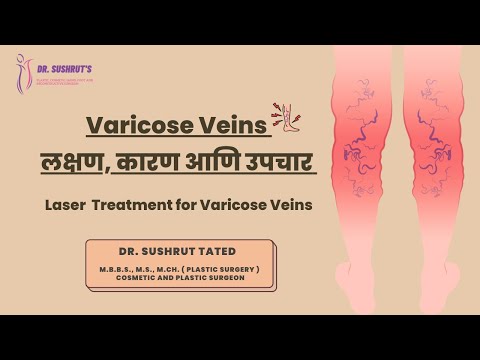


Why do varicose veins form?
Leg veins carry blood back to the heart against gravity, helped by one-way valves. When valves in the main surface veins of the leg weaken, blood flows backwards and pools, stretching the veins until they bulge and twist. Long hours of standing, pregnancy, weight, age and family history all raise the risk. Treatment works by closing or removing the faulty vein so blood takes the healthy deep veins instead.
Do all varicose veins need treatment?
No. Many cause no problems. Treatment is usually advised when veins cause aching, heaviness, swelling or cramps, when the skin over the ankle darkens, hardens or develops eczema, after a bleed from a vein, or when an ulcer has formed or healed. A colour Doppler ultrasound scan maps which veins are leaking before any treatment is planned.
How does laser treatment work?
Endovenous laser ablation (EVLA) is done under local anaesthetic, guided by ultrasound. A needle is placed into the faulty vein, usually near the knee, and a thin laser fibre is passed up inside it. Fluid is injected around the vein to numb it and protect the surrounding tissue. As the fibre is slowly withdrawn, heat seals the vein shut. The body gradually absorbs the closed vein. Radiofrequency ablation works the same way with a different heat source.
How does surgery work?
Traditional surgery ties off the faulty vein where it joins the deep vein in the groin or behind the knee (high ligation) and pulls out the length of the vein (stripping), usually under spinal or general anaesthetic. Smaller bulging branches can be removed through tiny cuts (phlebectomy), which is often combined with either approach.
Varicose veins laser vs surgery at a glance
| Laser (EVLA) | Surgery (ligation and stripping) | |
|---|---|---|
| Anaesthesia | Local | Usually spinal or general |
| Cuts | Needle puncture | Groin or knee cut plus small cuts |
| Pain afterwards | Usually mild | More bruising and pain |
| Walking | Same day | Same day or next day, slower |
| Back to desk work | Within a few days | Often one to two weeks |
| Closure of the vein | High | High |
| Recurrence over years | Similar | Similar |
| Main risks | Bruising, tightness, skin burns or nerve irritation (uncommon), clots (rare) | Bruising, wound infection, nerve injury, clots (rare) |
Large reviews comparing the two found similar rates of veins coming back over the following years, with laser offering an easier recovery. This is why NICE guidance recommends endothermal ablation first for suitable veins, then foam sclerotherapy, then surgery if neither is suitable.
When is surgery still the right choice?
Surgery or a combined approach may suit veins that are very large or twisted near the junction, veins too tortuous for a fibre to pass, or recurrent veins after earlier treatment. Some surgeons combine ligation at the junction with laser of the trunk. At this clinic, Dr. Sushrut uses ligation at the junction together with endovenous laser where the vein anatomy calls for it, after a Doppler scan.
What other treatments are there?
- Foam sclerotherapy: a medicine foam injected into the vein to close it, useful for smaller or recurrent veins.
- Compression stockings: ease symptoms when treatment is not wanted or not possible, but do not remove the veins.
- Lifestyle measures: walking, raising the legs, weight control and avoiding long periods of standing still.
What is recovery like after laser?
| Time | What to expect |
|---|---|
| Day of treatment | Walk out; short daily walks advised |
| First week | Bruising and a pulling feeling along the vein |
| One to two weeks | Compression stockings as advised; most normal activities |
| Six weeks | Follow-up scan or review; small residual veins can be treated |
Seek urgent care for calf pain and swelling, chest pain or breathlessness after any vein treatment.
Myths about varicose vein treatment
- “Laser burns the skin from outside.” The heat is delivered inside the vein.
- “Once treated, veins can never return.” New veins can develop over time.
- “Varicose veins are only cosmetic.” Some lead to skin damage and ulcers.
- “Stockings cure varicose veins.” They relieve symptoms only.
What to ask before choosing
- What did my Doppler scan show, and which veins are leaking?
- Am I suitable for laser, and if not, why?
- Will small branches be treated at the same time?
- How long will I need stockings and time off work?
For assessment and treatment options, see varicose vein treatment. Long-standing vein disease can cause leg ulcers; read about chronic wound treatment.
Frequently asked questions
Is laser treatment for varicose veins permanent?
The treated vein is sealed and usually stays closed. New varicose veins can still form over the years because the tendency to vein disease remains, whichever treatment is used.
Is laser better than surgery for varicose veins?
For most people with a faulty main leg vein, guidelines recommend endothermal ablation (laser or radiofrequency) first because recovery is quicker with similar long-term results. Surgery remains useful for some vein shapes and sizes.
How soon can I walk after laser treatment?
Usually the same day. Walking is encouraged straight away, and most people return to desk work within a few days.
Do I need to wear stockings afterwards?
Compression stockings are usually advised for a short period after treatment. Your surgeon will tell you how long.
Are varicose veins dangerous if left untreated?
Many are harmless, but some lead to swelling, skin darkening, eczema, bleeding or leg ulcers. These changes are reasons to be assessed.
References
- Varicose veins: diagnosis and management (CG168). National Institute for Health and Care Excellence (NICE).
- Varicose veins. NHS.
- Endovenous ablation therapy (laser or radiofrequency) or foam sclerotherapy versus conventional surgery (Cochrane review). Cochrane Database of Systematic Reviews (PubMed).
- Endovenous ablation (radiofrequency and laser) and foam sclerotherapy versus conventional surgery (Cochrane review, great saphenous vein). Cochrane Database of Systematic Reviews (PubMed).


